

Written by Søren Vasø
Follow on LinkedIn and Substack
18th of October 2024
Most B2B SaaS companies treat their demo call as the gateway to everything.
Want to see pricing? Book a demo.
Want to see how it works? Book a demo.
Want to know how we work with your industry? Book a demo.
The logic seems sound. More demos = more pipeline.
But here's what the data actually shows: you're spending sales time educating people who could educate themselves while losing the ones who won't wait.
The price you pay is higher CAC, smallere deals and less revenue. Let me walk through how we can calculate this. Step by step.
Not everyone who books a demo wants to buy
I mapped out 13 reasons people book demos. Here's what I found:
Reason
No-fit (and spam)
Feel and look
Pricing
How it works
Industry knowledge
Specific use cases
Competitive validation
Integration fit
Stakeholder alignment
Champion building case
Security/compliance
Confirmation bias
Ready to buy
What they really want
"I thought you did something else"
"Do I like it?"
"What does it cost?"
"Is it easy to use?"
"Have you it for someone like me?"
"Can you solve THIS problem?"
"I'm comparing you to others"
"Does this plug into our stack?"
"I need to show my boss"
"I need ROI proof"
"Can you pass our vendor review?"
"I've decided, I need validation"
"Let's start paperwork"
Intent level
Zero
Low
Low
Low
Medium
Medium
Medium
Medium
High
High
High
High
Very high
A huge chunk of your demos are low-intent information-gathering sessions. They're not ready to buy. They shouldn't need a 45-minute call with your AE to find out what you cost.
Let's distribute into percentages
These aren't research-backed numbers. This is me grabbing all the research I could find, cross-matched findings and adding my own industry experience.
Intent level
Zero (noise)
Low (info-seeking)
Medium (validation)
High (ready to engage)
Very High (ready to buy)
% of demos
~10%
~35%
~30%
~20%
~5%
Reasons
No-fit, spam, competitors scouting
Pricing, feel & look, how it works
Specific use cases, industry fit, competitive
validation, integration fit
Stakeholder alignment, ROI proof, security/compliance,
confirmation bias
Ready to start paperwork
75% of your demos are with people who aren't ready to engage or buy. They're gathering information that could be on your website.
Research backs this up
HockeyStack analyzed 31 million data points across 80 B2B SaaS companies. What they found: Transparent pricing generates 39% fewer form submissions but convert into pipeline 1.7x better.
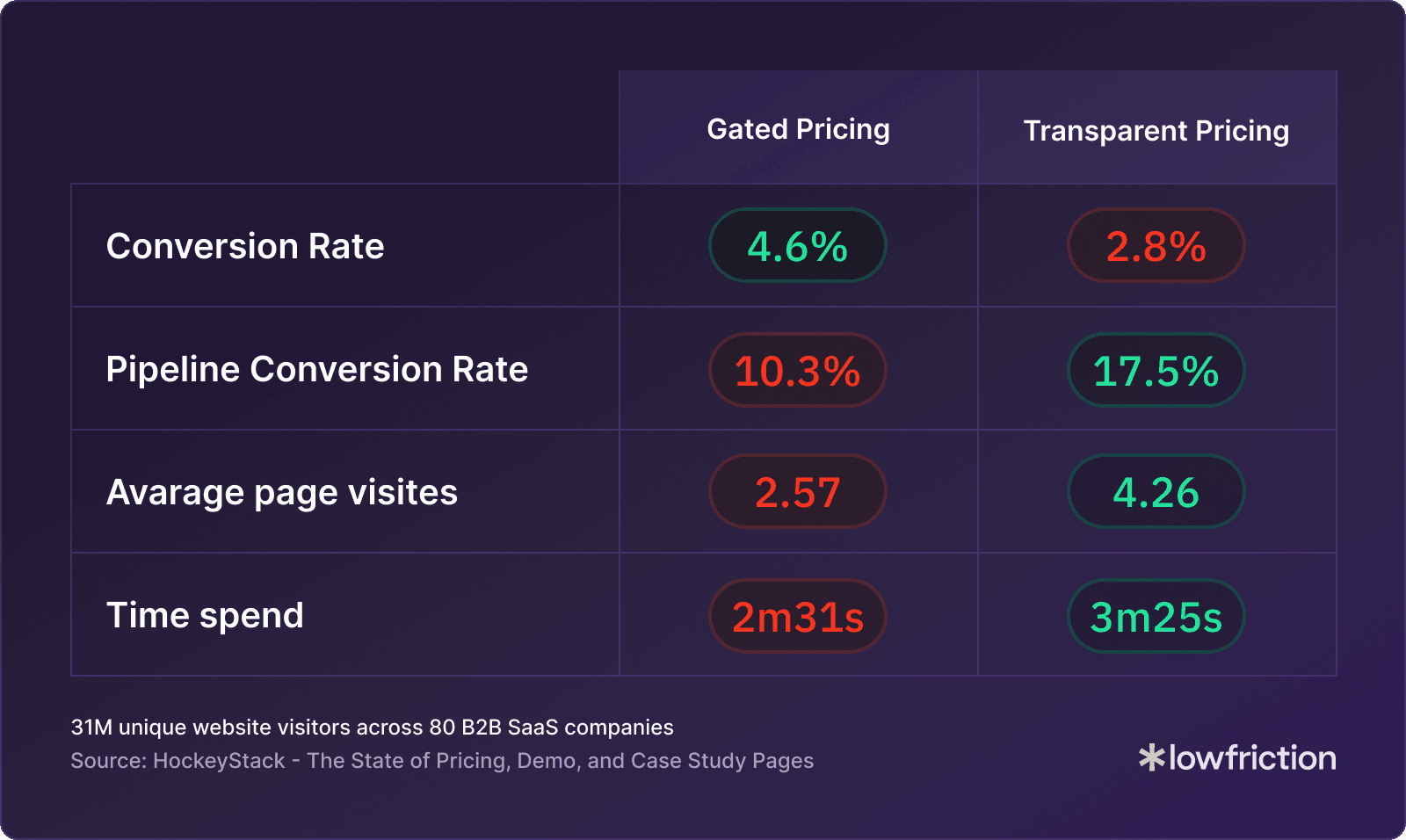
Fewer leads. Better quality.
Why? Because when you hide pricing, you attract "information" submissions. When you show it instead, you will see fewer bad-fit lead and more high-intent buyer submissions. High friction dilutes quality.
What if you removed buyer friction from every demo entry point?
Let's say you commit to lowering buyer friction across the board, not just on your pricing page. You provide a self-service alternative for every question that currently requires a demo:
Demo reason
Pricing
Feel and look
How it works
Industry fit
Specific use cases
Competitive validation
Stakeholder alignment
ROI proof
Security/compliance
Integration fit
Low friction alternative
Pricing page
Real product visuals, video demo, free trial
Product tours, tutorials, video demo, sandbox, free trial
Industry pages, vertical case studies
Use case library or pages
Comparison pages, reviews, case stories
Buyer guides, internal positioning docs, templates
ROI calculator, implementation timelines, case stories
Trust center, compliance page
Technical docs, integration directory
What happens? A massive drop from some intent categories.
Intent level
Zero (noise)
Low (info-seeking)
Medium (validation)
High (ready to engage)
Very High (ready to buy)
% of demos
~10%
~35%
~30%
~20%
~5%
Reduction
50%
75%
60%
10%
0%
Reasons
No-fit, spam, competitors scouting
Pricing, feel & look, how it works
Specific use cases, industry fit,
competitive validation, integration fit
Stakeholder alignment, ROI proof,
security/compliance, confirmation bias
Ready to start paperwork
Again, these directional estimates based on implementing the low-friction approach in multiple SaaS companies. You'll also see increases in other categories, but I've excluded those to keep the calculation clean.
The triple multiplier effect
This affects lead quality massively. We've removed 51% of the leads from the baseline. The ones that get through to a demo are more likely well-educated, high-intent buyers. And that has an impact on two more numbers:
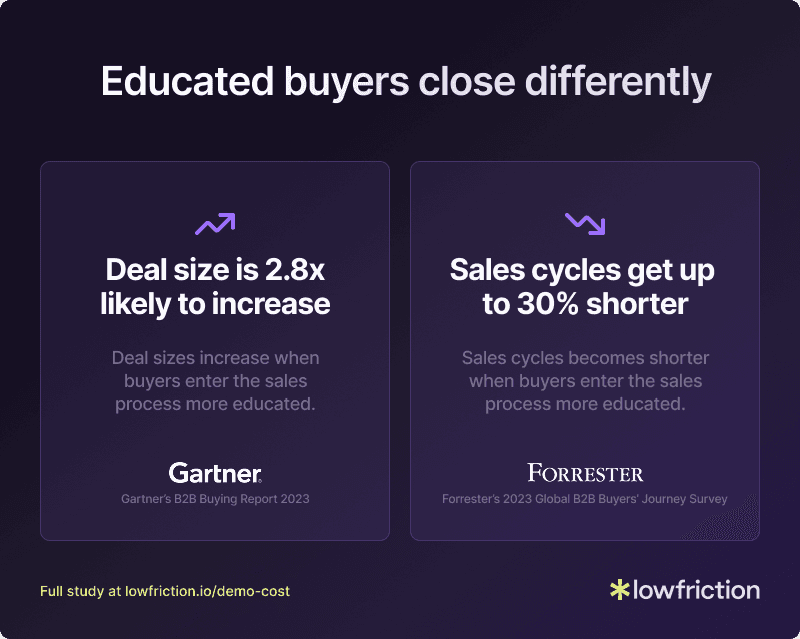
Sales cycles get 30% shorter (source)
Deals are 2.8x more likely to close at a higher deal size (source)
Translating the “2.8x more likely” into a specific % requires interpretation. I'm using a conservative 15% here. Educated buyers close faster. Spend more. Waste less of your sales team's time. These effects compound.
Let's do the math
We'll track 100 people who need information as a cohort over 90 days. We'll compare two models:
Sales Rep model
No self-service. Everyone needs a demo to get answers.
Self-service model
Comprehensive self-service content. Sales only talks to qualified, high-intent buyers.
Baseline assumptions
— Average sales cycle: 90 days
— Average deal size: €15K
— Intent distribution matches the 13 reasons table above
Sales Rep model: 100 people, 100 demos
Without self-service, every question requires a sales conversation. All 100 people book demos. Sales talks to everyone, regardless of intent level.
Intent level
Zero
Low
Medium
High
Very High
Total
Win rate
0%
5%
15%
40%
80%
# of people
10
35
30
20
5
100
Deals closed
0
1.8
4.5
8
4
18 deals
Result: 100 demos produce 18 deals over 90 days.
Self-service model: 100 people, 60 demos
With comprehensive self-service, people get answers without sales time. Bad fits self-disqualify. Lower-intent buyers research until they hit the right threshold.
High-intent buyers book demos right away. Some lower-intent buyers who can't find their specific answer also book.
Intent level
Zero
Low
Medium
High
Very High
Total
Win rate
0%
5%
15%
40%
80%
# of people
10
35
30
20
5
100
# of demos
5
9
12
18
5
49
Deals closed
0
0.5
1.8
7.2
4
13.5 deals
Now 100 people book 49 demos instead of 100. The remaining 51 people are absorbed by self-service content in two directions:
Self-disqualifiers (40 people)
They find their answers. Discover it's not a fit. Leave without wasting sales time.
5 Zero-intent: Were never going to buy
21 Low-intent: Price too high, features don't match, timing wrong
13 Medium-intent: Found a better-fit competitor
1 High-intent: Budget pulled
Returners (11 people)
They research independently. Build internal cases. Compare options. Mature from lower intent to high intent. Return for demos when they are ready to talk.
Original intent
Low
Medium
High
Total
Using self-service
26
18
2
51
Return rate
~20%
~25%
~50%
Return as demo
0
0.5
1.8
11
These 11 return as High or Very High intent. They close at 45% (blended high-intent win rate). 11 demos produce 5 additional deals.
Result: 60 demos produce 18.5 deals over 90 days.
Cohort comparison
We now have all our data from the two different models. On produced 100 demos and 18 deals, the other 60 demos and 18.5 deals. To understand how the unit economics is impacted, we need to add sales cost as it's one of the biggest drives of CAC. We also need to understand how much time we use per demo.
We use this as baseline for the calculation.
Fully loaded AE cost: €100K/year (€48/hr)
Average demo time: 1.5 hours (including prep and follow-up)
Here is the full comparison:
COHORT COMPARISON
Sales Rep Model vs Self-Service Model
Metric
Demos
High-intent demos
High-intent %
Total demo hours
Demo hours per deal
Sales cost per demo
Avg deal size
Deals closed
Total revenue
Sales cycle
Sales Rep
100
25
25%
150
8.3
€400
€15K
18
€270K
90 days
Self-service
60
28
47%
90
4.9
€235
€17.5K
18.5
€319K
63 days
Change
-40%
+12%
+88%
-40%
-41%
-42%
+15%
+3%
+18%
-30%
What this actually means
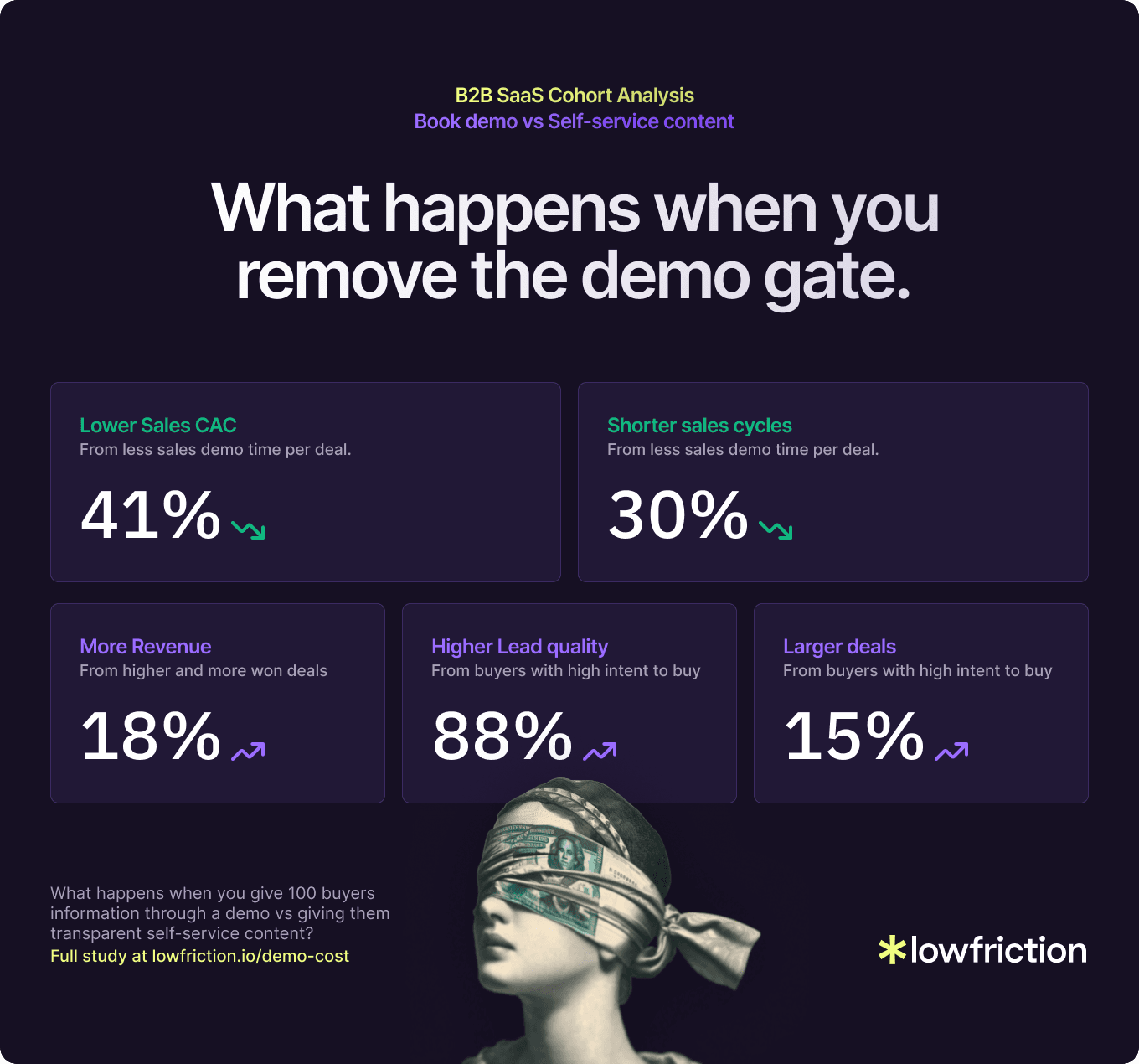
By the end of 90 days, both cohorts produce roughly the same number of deals. But the economics are completely different:
1. Lower CAC. You spend 41% less sales demo time per deal. That's real margin.
2. Larger deals. Educated buyers close bigger. They know what they want. They're willing to pay for it.
3. Faster cash. A 30% shorter sales cycle means you collect revenue earlier. That's cash flow.
4. Shorter CAC payback. If your sales part of CAC drops 42% and deal size rises 15%, you recover acquisition costs faster. That's the number investors and CFOs care about.
5. More revenue. 18% more from the same input. With less effort.
When you add these effect together, it's not small difference between high and low buyer friction.
So why isen’t more companies doing this?
I speculate in two reasons:
Marketing isn't measured on revenue. Their job is to create leads for sales. By every measurable angle, the high-friction model looks better. It generates more leads. You can't fix this until you stop treating marketing and sales as separate entities with different goals and understand the full buyer journey's impact on your business
Revenue leaders were trained on playbooks where early sales intervention was the goal. Buyer behavior and SaaS economic models have changed, but moving away from what worked earlier is difficult, especially when this new playbook isen’t considered best pratice.
This is a strategic decision revenue leadership must make. They need to reallocate resources and try things they've never done before. The biggest objection I still hear:
"Our business will suffer if we don't capture leads and instead give away our pricing and more.”
I'm here to tell you it's not true. If you don't believe me, listen to the market leaders. I ran a study of the 50 fastest growing companies of 2025.
50 out of 50 subscribe to the low-friction model.
Not most of them. ALL of them.
Buyers want this.
The market leaders are doing it.
Why aren't you?
A note on the numbers
These aren't lab-tested figures. There's no single study that connects all these dots (yet). This is a directional model. Built from the research that does exist (HockeyStack, Forrester, Gartner and more) combined with industry experience and informed estimates.
My goal wasn't to hand you a CFO-ready ROI deck. It was to show that the math behind low friction works. Even when you adjust the inputs.
So challenge it.
I'm building a calculator where you can input your own numbers. If you want it when it's done, write me at soren@lowfriction.io.
I'm part of a community of marketers who believe removing friction builds better businesses. If you find evidence otherwise, I want to know.
The upside I left out
I tried to stay true to the numbers in each model. I didn't add the other effects I've seen every time I've been part of making a buying journey low friction:
More inbound leads.
People like your brand more. They appreciate transparency. Your valuable content now affects search rankings (especially AI citations) which drives more traffic and inbound leads.
Cleaner pipeline.
Everyone feels the pressure of getting deals in, so reps add deals they hope will close, even when they know better. This bloats your forecast, breaks your percentages and wastes time on low-intent leads. With the low-friction model, there are fewer bad deals to work on.
These are real bonuses, not included in the math above.
Conclusion: Your demo gate doesn't protect your business. It hurts it.
The cohort analysis tells a clear story. Both ways produce similar deal volume, but the low friction model is superior when it comes to unit economics. The question isn't whether you can afford to lower the friction for your buyers.
It's whether you can afford not to.